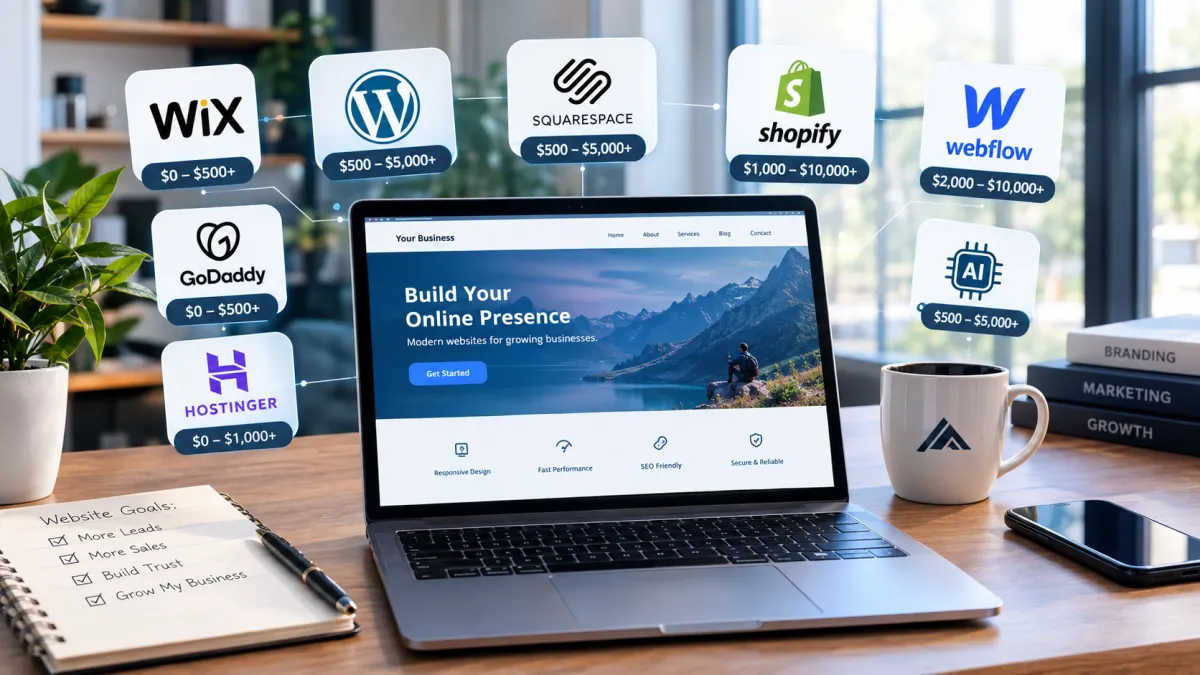
How Much Does a Small Business Website Cost in 2026?
How Much Does a Small Business Website Cost in 2026?
If you're planning to build a website for your small business, one of the first questions you'll probably ask is:
How much does a website cost?
The honest answer is: it depends.
A small business website can cost relatively little if you build it yourself using a website builder. A professionally designed website can cost more, while a custom website with advanced functionality can require a significantly larger investment.
The difference isn't necessarily because one provider is "overcharging."
It's because not every website is the same.
A five-page service website, an e-commerce store, and a custom business platform are completely different projects.
In this guide, we'll break down what actually affects website costs in 2026, what you should expect to budget for, and how to determine the right approach for your business.
The Short Answer
There are several common ways to build a small business website.
DIY Website Builder
You build the website yourself using a platform such as Wix, Squarespace, GoDaddy, or an AI website builder.
The upfront cost can be relatively low, but you are responsible for the time and effort required to build, write, optimize, and maintain the website.
Freelancer
A freelancer can design and build your website for you, often at a lower cost than a larger agency.
The final price depends on factors such as:
Experience
Number of pages
Design complexity
Platform
Functionality
Content requirements
SEO requirements
Professional Web Design Agency
An agency may provide more than website development.
A project can include:
Strategy
UX planning
Custom design
Development
Content
SEO
Analytics
Conversion optimization
Integrations
Ongoing support
Custom Website Development
Custom development is appropriate when your business needs functionality that standard website builders cannot easily provide.
Examples include:
Customer portals
Membership systems
Advanced booking systems
Custom dashboards
CRM integrations
API integrations
Advanced e-commerce
Custom business applications
Current 2026 website-cost research places DIY websites at the low end, professionally designed sites commonly in the thousands of dollars, and complex custom projects at $10,000 or more.
So instead of asking:
"What's the cheapest website I can get?"
A better question is:
"What does my business actually need its website to accomplish?"
What Does a Small Business Website Usually Cost?
There is no single price that applies to every business.
For planning purposes, current 2026 guidance provides some useful ranges.
DIY Website
A basic DIY website can potentially be built for under $500 upfront, depending on the platform, domain, hosting, and features you choose.
Professionally Designed Website
A simple professionally designed website can commonly start around $1,000–$5,000, depending on the scope and provider.
Complex or Custom Website
Websites requiring custom functionality, advanced integrations, or more extensive development can reach $10,000+.
These are planning ranges—not fixed industry prices.
The actual cost depends on what you're building, who is building it, what platform you use, and what is included in the project.
Why Can Website Prices Be So Different?
Imagine asking three companies to build you a "business website."
You could receive three completely different quotes.
That doesn't necessarily mean one company is wrong.
The problem is that "business website" doesn't define the scope of the project.
A website quote can change significantly based on several factors.
1. Number of Pages
A five-page website requires considerably less work than a 30-page website.
A basic business website might include:
Home
About
Services
Blog
Contact
A larger business may need:
Multiple service pages
Industry pages
Location pages
Case studies
Resources
Team pages
Landing pages
Blog categories
Every additional page can require:
Design
Content
SEO
Development
Testing
That's why page count matters when comparing website quotes.
2. Template vs. Custom Design
This is one of the biggest differences between website projects.
Template-Based Website
A template provides an existing design structure that can be customized with your:
Logo
Colors
Images
Text
Sections
This can make the project faster and less expensive.
Custom Website Design
A custom website is designed around the company's:
Brand
Audience
Goals
Competitors
Content
User journey
This generally requires more design and development work.
Neither approach is automatically better.
The right choice depends on the business.
3. Website Functionality
A basic website may only need:
Navigation
Informational pages
Contact forms
Mobile responsiveness
Other businesses may need:
Online payments
Booking systems
E-commerce
Memberships
Customer accounts
Live chat
CRM integration
Email automation
Advanced forms
Custom calculators
Scheduling
Third-party APIs
The more functionality your website requires, the more development work may be involved.
4. E-Commerce
Selling products online introduces another level of complexity.
An e-commerce website may require:
Product pages
Product categories
Shopping cart
Checkout
Payment processing
Shipping
Tax configuration
Inventory management
Customer accounts
Order management
Analytics
Marketing automation
That's why an online store generally requires a different budget from a basic informational website.
Current 2026 research also shows that e-commerce website costs can range from relatively inexpensive setups to $10,000+ custom projects, depending heavily on the store's complexity and requirements.
5. Content Creation
Website design isn't the only thing that takes time.
Someone needs to create the content.
That can include:
Homepage copy
Service descriptions
About page
Product descriptions
Blog content
FAQs
Calls-to-action
Images
Videos
If your business provides the content, you may reduce the project cost.
If the designer or agency is responsible for creating it, the project may cost more.
6. SEO
SEO shouldn't simply mean adding a few keywords to your website.
A proper SEO foundation can involve:
Keyword research
Search intent
Site architecture
Page structure
Metadata
Internal linking
Technical SEO
Image optimization
Local SEO
Content strategy
Analytics
A website built specifically to support organic search can therefore require more planning than a simple brochure website.
7. Integrations
Modern business websites often connect with other systems.
For example:
Website → CRM → Email → Sales Team
Or:
Website → Booking System → Calendar → Confirmation Email
Or:
Website → E-Commerce → Payment → Inventory → Shipping
Every additional integration introduces additional technical considerations and development work.
8. Mobile Responsiveness
Your website needs to work properly across different screen sizes.
That means testing and optimizing for:
Desktop
Laptop
Tablet
Mobile phones
A website that looks great on a desktop but is difficult to use on a phone isn't a finished business website.
9. Website Speed and Performance
Performance also matters.
Large images, unnecessary scripts, excessive third-party tools, and poorly optimized code can affect loading performance and user experience.
A professional website should be designed with performance in mind rather than treating speed as an afterthought.
Don't Forget the Ongoing Costs
One of the biggest mistakes business owners make is thinking the website cost ends when the site launches.
It doesn't always.
You may also need to budget for:
Domain
Your domain name needs to be registered and renewed.
Hosting
Your website needs somewhere to run.
Maintenance
Depending on the platform, you may need updates, backups, security monitoring, troubleshooting, and technical support.
Premium Tools
Some platforms, plugins, themes, integrations, and marketing tools have separate costs.
Content
Your website may need new pages, blog posts, images, and other content over time.
SEO
If organic traffic is important to the business, SEO usually requires ongoing work rather than a one-time setup.
Current 2026 research shows that recurring costs can vary significantly. Hosting alone can range from a few dollars per month for basic shared hosting to hundreds of dollars per month for more advanced infrastructure, while maintenance costs depend heavily on the site's complexity and whether the work is handled internally or by a professional.
Is a Cheap Website Actually Cheaper?
Not necessarily.
Suppose Business A spends $500 on a basic website.
Business B spends $3,000 on a professionally planned website.
Business A may initially spend less.
But what happens if:
The website doesn't generate leads?
Customers can't find important information?
The site isn't optimized for search?
The design looks outdated?
The business needs a redesign next year?
The website can't support new functionality?
The original $500 wasn't necessarily a bad investment.
But the cheapest initial price isn't always the lowest total cost.
The goal should be to spend according to the website's purpose.
What Should You Spend on Your Website?
There isn't one number that applies to every small business.
Instead, consider the role your website plays.
If Your Website Is Mainly a Digital Business Card
A simple DIY or template-based website may be enough.
If Your Website Generates Leads
Consider investing more heavily in:
Design
Messaging
SEO
Conversion optimization
Forms
Analytics
If You're Selling Products
Your budget needs to account for e-commerce infrastructure and related functionality.
If Your Business Requires Custom Systems
You may need professional development and a significantly larger budget.
A Better Way to Set Your Website Budget
Instead of starting with a price, start with your goals.
Ask:
What do I want visitors to do?
Do you want them to:
Call?
Book an appointment?
Request a quote?
Submit a form?
Purchase something?
Subscribe?
Visit your location?
Then ask:
How important is the website to generating revenue?
If the website is expected to produce customers, it should be treated as part of your marketing and sales infrastructure—not simply an expense.
A strong small-business website should clearly communicate what the business does, establish credibility, and make it easy for visitors to take the next step.
Questions to Ask Before Accepting a Website Quote
Before signing a contract, make sure you understand what you're actually receiving.
Ask:
Is the design custom or template-based?
How many pages are included?
Who writes the content?
Is SEO included?
Is mobile optimization included?
Is the domain included?
Is hosting included?
Are forms included?
Are integrations included?
How many revisions are included?
Who owns the website?
What happens after launch?
Is ongoing maintenance available?
Are there additional software or licensing costs?
A low quote can become much more expensive when important items are added later.
How to Compare Two Website Quotes
Don't simply compare the final number.
Compare the scope.
For example:
Company A
$1,500
5 pages
Template design
Client-provided content
Basic contact form
Basic SEO setup
Limited revisions
Company B
$4,000
8 pages
Custom design
Content support
SEO foundation
Conversion-focused structure
Analytics setup
CRM integration
Mobile optimization
Post-launch support
At first glance, Company A looks cheaper.
But they're not necessarily selling the same thing.
Compare deliverables, not just price.
What Makes a Website Worth the Investment?
A website becomes more valuable when it helps your business accomplish measurable goals.
For example:
More qualified leads
More calls
More bookings
More online sales
Better search visibility
Stronger brand credibility
Better customer experience
More efficient lead management
That is why website ROI shouldn't be judged only by how much the website cost.
The better question is:
What is the website helping the business produce?
The Right Website Budget Depends on the Business
A startup validating an idea doesn't need the same website as an established company generating hundreds of leads every month.
A local contractor doesn't need the same infrastructure as an e-commerce brand.
A consultant doesn't need the same functionality as a SaaS company.
And a business that gets most of its customers through referrals may have completely different priorities than one relying heavily on Google search.
Your website budget should reflect your business model.
Should You Build It Yourself or Hire a Professional?
DIY can make sense if:
Your website is simple.
Your budget is limited.
You have the time.
You're comfortable learning the platform.
You don't need advanced functionality.
Professional web design may make more sense if:
Your website is a major lead source.
You compete in a crowded market.
SEO is important.
Your brand needs to stand out.
You need custom functionality.
You need integrations.
You don't have time to manage everything yourself.
There is no shame in either choice.
The important thing is understanding the trade-off.
DIY saves money but requires your time.
Professional development costs more but can save time and provide greater strategic and technical support.
The Bottom Line
So, how much does a small business website cost in 2026?
There isn't one universal price.
A DIY website can potentially cost under $500 upfront, a simple professionally designed website can commonly fall around the $1,000–$5,000 range, and complex custom projects can reach $10,000 or more. These figures are useful planning ranges, not fixed market prices, because the final cost depends on the platform, features, design, functionality, content, integrations, and level of professional involvement.
The important thing is not to ask:
"How can I get the cheapest website?"
Ask:
"What does my business need its website to accomplish?"
Once you know that, your budget becomes much easier to determine.
Ready to Build a Website That Fits Your Business?
At NeoCraft Digital, we believe your website should be built around your business goals, not an arbitrary package or template.
Whether you need a simple business website, a conversion-focused redesign, SEO-ready pages, custom functionality, or a broader digital marketing strategy, the right solution starts with understanding what your business actually needs.
Don't pay for features you don't need.
And don't cut costs on the things your business depends on.
Build the website that makes sense for where your business is today—and where you want it to go next.
Ready to discuss your website project?
Talk to NeoCraft Digital →